Wilson's storm petrel was included as a New Zealand bird species without locality in Buller's Birds of New Zealand, 1888. There are two subspecies: oceanicus whuich breeds on subantarctic islands in the South Atlantic and South Indian Ocean, and exasperatus which breeds on coasts and islands of Antarctica and is an uncommon passage migrant through New Zealand waters.
Wilson's storm petrel is one of the most abundant bird species in the world.
In the Antarctic Peninsula, The Wilson's storm petrel nests in cavities in glacial rubble and scree, and also in tunnels excavated by the birds under boulders. It is strictly nocturnal at the breeding sites to avoid predation by gulls and skuas, and will even avoid coming to land on clear moonlit nights. It is strictly pelagic outside the breeding season, and this, together with its remote breeding sites, makes it a difficult bird to see near land. Only in severe storms might this species be pushed into headlands. The birds return to their colonies in November-December and eggs are laid in mid-December. Both parents share the 39-48 day incubation period, taking alternative shifts of about 48 hours. Once the chicks hatch they are fed irregulary by both parents for up to 52 days. Fledging and dispersion begins in April-May.
The Wilson's storm petrel migrates from its Antarctic breeding grounds to north of the Equator in the Atlantic, Indian and Pacific Oceans. The Ross Sea birds and birds south of Australia, migrate to the Indian Ocean. They are gregarious at sea with flocks reaching several thousands at staging points during migration.
Wilson's storm petrel feeds over the continental shelf. They feed, typically of storm petrels, by running along the surface of the water with wings outstretched and bill, or their entire head, submerged in the water to scoop in their food, taking minutiae from the surface. They feed on crustacea, cephalopods, fish, and offal. They readily follow ships and attend trawlers, attracted by the left overs, and whales and dolphins.
The name commemorates the Scottish-American ornithologist Alexander Wilson.
— Greytown, 2008
Other common names: —
Wilson's Petrel
Description: —
Native bird
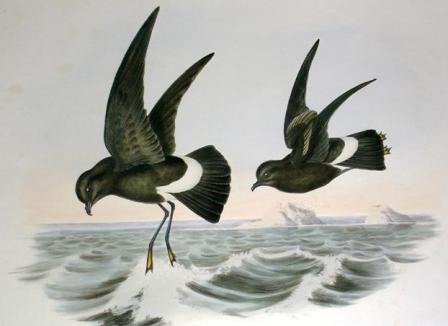
18cm, 35g, brownish black with faint diagonal grey-brown bar on upper wing,prominnat white rump, square tail, yellow webbed feet.
Where to find: —
Breeds subantarctic and Antarctica, including several colonies in the Ross Sea sector. Migrates to northern hemisphere.
Illustration description: —
Gould, John, Birds of Australia, 1840-48
Poetry: —
When it blows a hard gale of wind the Stormy Petrel makes its appearance. While the sea runs mountains high, and every wave threatens destruction to the labouring vessel, this little harbinger of storms is seen enjoying itself, on rapid pinion, up and down the roaring billows. When the storm is over it appears no more. It must have been hatched in Æolus's cave, amongst a clutch of squalls and tempests; for whenever they get out upon the ocean it always contrives to be of the party.
— Charles Waterton
Reference(s): —
Heather, B., & Robertson, H., Field Guide to the Birds of New Zealand, 2000.
Olliver, W.R.B., New Zealand Birds, 1955.
Page date & version: —
Saturday, 7 June 2014; ver2009v1