I had a call recently from Bill Sloan, retired vet and the local bird rescuer, to tell me that a Weka chick had been brought in and would I like to see it, knowing that I had never seen a Weka chick close up before.
Two children had found it all wet and bedraggled in a ditch in the Toatoa area and handed it in to the local office of the Department of Conservation who are mounting a Weka rescue campaign in the Toatoa and Whitikau valleys, the last remaining refuge for the Weka on the mainland in the North Island.
It was just ten days old, not much bigger than the chick of a domestic hen, but black all over, big black feet, black beak and black eyes. It was feeding well on egg and farex and when I last saw it a few days later it had grown considerably, cheeping away like any chick.
Wekas, or woodhens, are members of the rail family which are mainly aquatic birds, all capable of swimming well. Apart from the Pukeko and Weka, rails are secretive birds, usually found skulking in freshwater swamps and estuarine mangroves and reedbeds. Rails have slim bodies that help them move through dense vegetation, moderately long powerful legs with long unwebbed toes that help them walk through wetlands, and a short tail which is flicked up and down as they walk or swim. The rails are ground based birds that seem unwilling to fly and some, like the Weka and the Takahe, have the lost the ability to fly at all.
The Weka can be both inquisitive and pugnacious and in spite of being cooked and eaten by both Maori and the Pakeha settlers, the species seemed well able to resist the advent of man and his associated pests and remained abundant in many areas, only to vanish suddenly, between 1915 and 1940, from most of the North Island and parts of the South Island. It was abundant in the wider Gisborne region, its one remaining North Island habitat, until the early 1980s when it declined drastically from a population estimated to be approximately 88,000.
In 1991 and again in 1995 the Department of Conservation conducted surveys in the area, the results of which indicated that the bird is still in decline in Gisborne and surrounding areas. The most substantial numbers are in the recently populated Toatoa /Whitikau valleys with an estimated population of between 1000 and 1500 birds.
The Weka can raise up to four chicks a year and breed all year round if conditions are suitable and so it is not unusual to see a chick in the winter time or see a female with a juvenile and a chick in tow.
The natural diet of the Weka in forests is predominantly invertebrates and fallen fruits. Lizards, snails and the eggs and young of birds are also taken. Wekas readily kill mice, rats and young rabbits, and two were seen killing a stoat.
Weka are shy and retiring and are more often heard than seen. Their main call being a shrill far carrying double note coo-eet, normally heard in the early evening. They are usually seen only fleetingly as they run from one patch of cover to another.
But some do become cheeky and aggressive and have been blamed for damaging vegetable crops such as tomatoes and for stealing eggs from domestic hens. They will scavenge for scraps of food from campsites and farm yards and can make a nuisance of themselves in the vegetable garden, all of which is probably due to acute shortages of their preferred food.
However, the causes of the Wekas continued decline remains a mystery and is usually put down to pressure from predators. Sudden crashes in bird populations are not unusual but species normally recover when conditions are right. But one would think that if the Pukeko and the Australian quail can survive here with hunters, dogs and cats, stoats and rats, surely the Weka can as well. Perhaps all it might take is a bit of tolerance for these birds and a willingness to look out for them. And if they take a few eggs, does it matter?
As the great ecologist and social biologist E.O. Wilson says, species usually vanish, not in a dramatic cataclysm, but unnoticed, at the end of a decline when those who knew them could acknowledge that none had been seen around for awhile, that perhaps there were still a few to be found in such-and-such valley, where in fact a predator had already snatched the last living individual, a lonely male, from its perch.
Other common names: —
Woodhen
Description: —
Endemic bird
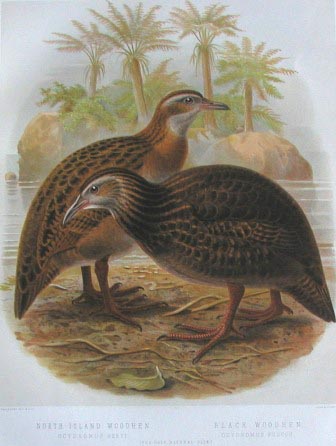
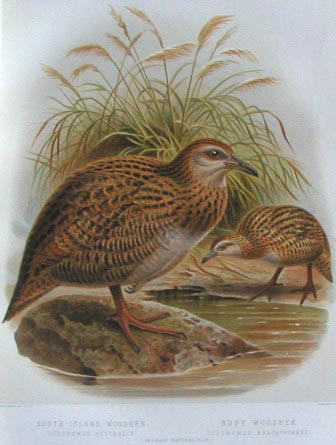
53 cm., males 1000 g., females 700 g., brown, streaked with black; North Island Weka, greyi, is greyer below and has brown legs; Buff Weka, hectori, is palest; Western Weka, australis, is more chestnut in colour except in Fiordland where a dark form is common; Stewart Island Weka, scotti, is the smallest and also has a dark form;
Where to find: —
Buff Weka became extinct in the eastern South Island but were introduced to the Chatham Islands where they are numerous; North Island Weka, refugee population Toatoa, east of Opotiki and on Mokoia Island, Lake Rotorua, Bay of Islands, Kauwau, Rakitu Islands; Western Weka remain common in the Marborough Sounds, Golden Bay and Northwestern Nelson, Westland south to Hokitika, introduced into Kapiti and other islands; Stewart Island Weka found on small islands in Foveaux Strait and the south coast of Strewart Island.
Youtube video —
Poetry: —
The Weka
Weka, O Weka, O little brown Weka,
Why do they hate you, and cry on your name?
They tell me you’re sly and you swoop without warning,
Your wings have no flight, and your beak, has no shame.
You’re gay as a gossip and vain as a man–child,
You snatch at a bright thing and bear it away.
You sing with your mate when all good birds are silent,
You’re gallant by night and your’re sidelong by day.
But its my pity your footprints grow rarer;
Little brown mischief, don’t slip from our sight.
Wicked and sweet are your eyes in the twilight,
Wistful and wild is your cry in the night.
— Eileen Duggan
E hia motunga o te Weka i te mahanga?
How often does the Weka escape from the snare?
Illustration description: —
Buller, Walter Lawry, Birds of New Zealand, 1888.
Reference(s): —
Heather, B., & Robertson, H., Field Guide to the Birds of New Zealand, 2000.
Oliver, W.R.B., New Zealand Birds, 1955.
Page date & version: —
Thursday, 5 June 2014; ver2009v1