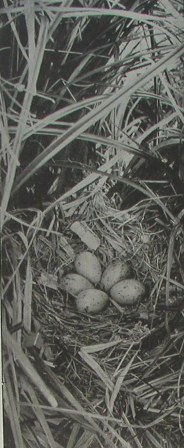
According the Oliver, the site of the pukeko's nest is perhaps most often in a raupo swamp where a large untidy structure of raupo leaves a foot or so high is built. Other sites are under large tussocks of flax, sedge or grass. I myself have found nests, neatly hidden from view, in the long fescue grass on the banks of the Waiotahi River in the eastern Bay of Plenty.
Pukeko have an extended nesting season usually from August to March but males may be seen treading the female as late as April and it is not unusual to see small chicks late in Autumn. The male has an elaborate courtship display, holding water weeds in his bill and bowing to the female with loud chuckles.
Each female lay up to six buff eggs with blotches of brown at the larger end. The eggs are roughly 50mm x 35 mm in size. Several hens may lay in the same nest so clutches may be very large.
Pukeko chicks are clothed along the spinal and other tracts with silver tipped blackish down, the crown of their heads are bald.
In New Zealand, where they have been studied most extensively, pukeko exhibit a variable mating system, commonly living in communal groups consisting of two or more breeding females that share a single nest with several breeding males as well as nonbreeding helpers of both sexes. All group members care for the young, so each chick may have an aunt or uncle as a minder.
The opposite of polygamy is polyandry, when a female has multiple mates. In cooperative polyandry two or more males live together with a female, both copulating with her and cooperatively caring for her offspring.
— Narena Olliver, 2008

Other common names: —
Purple gallinule, purple swamphen.
Description: —
Native bird
51 cm., males 1050 g., females 850 g., deep almost iridescent indigo blue. The back and wings black with a greenish gloss, undertail coverts are pure white, scarlet bill, orange-red legs.
Where to find: —
Abundant throughout New Zealand, in rough damp pasture near wetlands.
More Information: —
Credit for the photograph: —
Birds of Water, Woods and Waste, 1927.
Illustration description: —
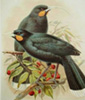
Rowley, G.D., Ornithological Miscellany, 1875-78.
Reference(s): —
Heather, B., & Robertson, H., Field Guide to the Birds of New Zealand, 2000.
Oliver, W.R.B. New Zealand Birds, 1955.
Guthrie-Smith, H., Birds of Water, Woods and Waster, 1927.
Jameison, I., & Craig, J., Animal Behaviour, 1987.
Page date & version: —
Monday, 2 June 2014; ver2009v1