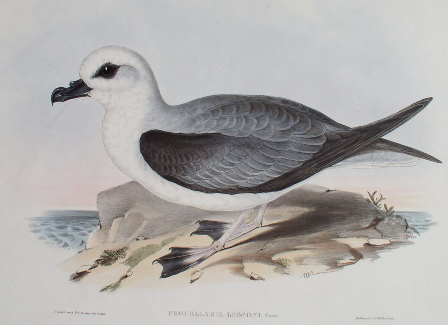
“The white-headed petrel was collected during Cook’s first voyage to the eastward of the Kermadecs and later in Bass Strait. The first published description of it, however, was that by Garnot in 1826, his specimen being obtained at Cape Horn”, Oliver records. “It was collected in New Zealand seas during the voyage of the Astrolabe and Zelee in 1839, and next appears to have been observed north of Great Barrier Island by Hutton in 1866.”
The White-headed petrel ranges throughout the sub-Antarctic and breed on most sub-Antarctic islands except South Georgia. The White-headed petrel is powerful and fast in flight. These birds are mostly found at Kerguelen, Macquarie Islands and New Zealand’s Antipodes and Auckland Islands, but cats, rats and skuas are reducing their numbers.
Adults return to their colonies in late August to clean out their burrows and to mate. They nest in burrows and start laying from November through to December, producing just one egg. Both parents incubate the egg for about 60 days and raise the chick for 100 days. They come in to feed their chicks at night, like most petrels. The chicks leave the colonies around May.
White-headed petrels feed far from the nest, sometimes travelling to the South Atlantic. They eat mainly celeaphods but also crustaceans and latern fishes. While the parents are away, the chicks may defend themselves by hissing and ejecting small amounts of stomach oil.
— Greytown, 2006
Other common names: —
Description: —
Native bird
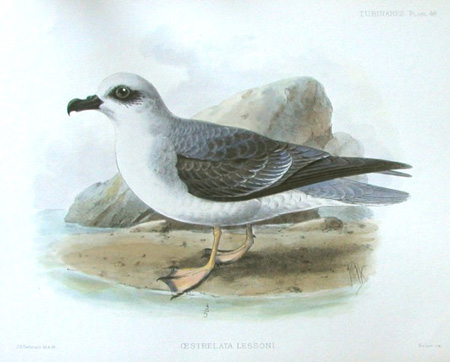
43 cm., 600 g., head and under surface white, dark eye patch, upper surface from the hind neck pale grey but darker on the lower back, wings brown-black, feet pink.
Where to find: —
Range between pack ice and 45 degrees south but move north to 30 degrees south in the winter. Regularly beach-wrecked on the west coast of the North Island in winter and spring.
Illustration description: —
Gould, J. Birds of Australia, 1840-48.
Godman, Frederick du Cane, Monograph of the Petrels, 1907-1910.
Reference(s): —
Heather, B., & Robertson, H., Field Guide to the Birds of New Zealand, 2000.
Oliver, W.R.B., New Zealand Birds, 1955.
Readers Digest Complete Book of NZ Birds, 1985.
Page date & version: —
Sunday, 1 June 2014; ver2009v1