Another wet autumn morning; a good day for ducks, as they say, or perhaps not so good as it is the duck-shooting season. I can hear a California quail calling somewhere in the distance and a beautiful cock pheasant is parading around the back yard as if it were spring already.
How do the quail and the pheasants survive around here, I wonder, with all the dogs and cats and rats? Indeed they seem to flourish and even prefer to live in an urban environment where they are safe from gunshot. But then, of course, they are evolutionarily adapted to living with predators, unlike our own birds.
The contrast between our native grey duck and the introduced mallard duck, Anas platyrhychos, readily demonstrates how different evolutionary histories influence the fate of these birds, influences their survival. There used to be literally millions of grey duck in New Zealand. Charlie Aramoana, Kaumatua of Upokerehe, the guardians of Ohiwa Harbour, remembers when the harbour was black with them. Even in 1970 there were 1.5 million but now the numbers have shrunk to less than 500,000 nationwide.
In a recent report to the New Zealand Fish and Game Council, wildlife biologist Murray Williams says that it is competition and hybridisation with mallard which has led to their decline. He says that mallard come from an open pothole grassland country created during the retreat of the Northern Hemisphere ice sheets. They need an open landscape whereas the grey duck evolved in wetlands where trees and bush cover dominated. Mallard are pre-adapted to the ponds and dams that came with the clearing of the bush and the creation of open farmland. However, he says that if we had not introduced mallard here, the grey duck would have expanded their range of habitats to exploit the pastoral ponds and wetlands as has happened in Tasmania and many parts of southern Australia where Mallard were not introduced.
Mallard, he continues, have a number of other advantages. They are bigger than greys and will physically oust them in a scrap. They also breed more profusely. In their natural range, mallard had to contend with numerous predators, raccoons, foxes, polecats, crows, hawks and ravens. They also had to handle a demanding annual migration, each leg of which would involve a journey of several thousand kilometers. So they responded with a large clutch size and a rapid re-nesting response. In New Zealand, there is no need for the mallard to migrate and depredation from predators is minimal, resulting in a high survival rate. In contrast the grey duck, evolving in the more our benign environment, has an average clutch of just eight eggs, three less than the mallard average.
This might to enough to put the grey at a serious disadvantage but there is not only ecological competition but sexual competition as well. Mallard are sexually more aggressive than the greys. Mallard drakes pair only briefly. Once the female has laid her eggs and commenced incubation, the male moves on to other females that are still laying and forcefully mates with them. Up to one third of ducklings in any mallard brood are fathered by males other than the primary mate. Grey females also become targets for mallard attention with the inevitable hatching of grey/mallard hybrids.
Murray Williams says that the consequence of this is that we already have an extensive hybrid population and that the creation of a uniquely New Zealand duck, the grallard, is well on the way.
International conservation agencies such as the IUCN, The World Conservation Union, view interbreeding very seriously and have already ranked the grey duck in New Zealand as an endangered species. The Department of Conservation has not yet indicated that it shares the IUCN concern.
Other common names: —
Pacific duck, black duck.
Description: —
Native bird
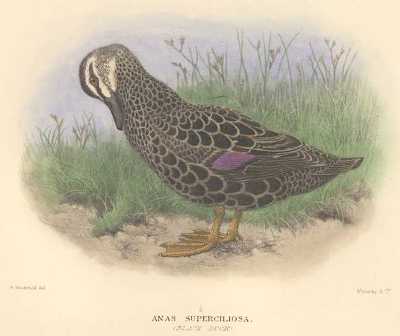
55 cm., males 1100 g., females 1000 g., like female mallard but with darker striped pale head, grey bill, greenish brown legs, green speculum with black borders and thin white band on trailing edge.
Where to find: —
Widespread.
Poetry: —
The Duck and the Kangaroo
Said the Duck to the Kangaroo,
'Good gracious! How you hop!
Over the fields and the water too,
As if you never would stop!
My life is a bore in this nasty pond,
And I long to go out in the world beyond!
I wish I could hop like you!'
Said the Duck to the Kangaroo.
'Please give me a ride on your back!'
Said the Duck to the Kangaroo.
'I would sit quite still, and say nothing but "Quack,"
The whole of the long day through!
And we'd go to the Dee, and the Jelly Bo Lee,
Over the land and over the sea; -
Please take me a ride! O do!'
Said the Duck to the Kangaroo.
Said the Kangaroo to the Duck,
'This requires some little reflection;
Perhaps on the whole it might bring me luck,
And there seems but one objection,
Which is, if you'll let me speak so bold,
Your feet are unpleasantly cold,
And would give me the roo -
Matiz!' said the Kangaroo.
Said the Duck, As I sate on the rocks,
I have thought over that completely,
And I bought four pairs of socks
Which fit my web-feet neatly.
And to keep out the cold I've bought a cloak,
And every day a cigar I'll smoke,
All to follow my own dear true
Love of a Kangaroo!'
Said the Kangaroo,'I'm ready!
All in the moonlight pale;
But to balance me well, dear Duck, sit steady!
And quite at the end of my tail!'
So away they went with a hop and a bound,
And they hopped the whole world three times round;
And who so happy, - O who,
As the Duck and the Kangaroo?
— Edward Lear
Illustration description: —
Mathews, G.M., The Birds of Australia, 1910-1927.
Reference(s): —
Heather, B., & Robertson, H., Field Guide to the Birds of New Zealand, 2000.
Oliver, W.R.B. New Zealand Birds, 1955.
Williams, M., Basse, B. Competition and hybridisation between indigenous grey duck and introduced mallard in New Zealand, Report to the Fish and game Council, 2003.
Page date & version: —
Friday, 30 May 2014; ver2009v1