A certain amount of romance surrounds the history of the discovery of Moa. In 1839, John W. Harris, a Poverty Bay flax trader who was a natural history enthusiast, was given a piece of unusual bone by a Maori who had found it in a river bank. He showed fragment of bone to his uncle, John Rule, a Sydney surgeon. This bone, a fragment of a femur of the species now known as Dinornis novaezealandiae, by 1839 had ended up in England and in the hands of Professor Richard Owen. After careful examination of the bone, Owen made his famous pronouncement; “there had existed and perhaps still exists in New Zealand a race of struthious birds of larger and more colossal size than the ostrich or any known species.” This deduction was made from a mere fragment of a femur some six inches, (150 cm.,) in length.
After this the rush was on to collect more bones. There are some great stories associated with discovering Moa bones; one of the best is about a schoolboy, Jim Eyles, who in 1939, at the Wairau Bar, discovered a Moa hunter burial complete with tools and ornaments and a complete Moa egg which had been drilled at one end to extract the contents. Evidence suggests that Maori herded Moa, probably with the help of dogs, along the eight kilometre-long gravel bar at Wairau to an encampment at the end where ovens were ready.
Subsequent investigations showed that early Maori, some 600 years ago, utilised Moa for a variety of purposes. They fashioned fish hooks, harpoon heads, necklaces, pendants and other tools from the large leg bones, while the skins and feathers were used for clothing. Besides being eaten, the eggs were emptied and used as water containers.
Europeans when they arrived crushed the bones for fertiliser, there were so many around in some areas.
The name Moa itself is a matter of some interest, study and contention. A review of all the myths and legends by Colenso yielded only one instance where the word was featured, concerning the fires of Tamatea. An old Maori chief, Urupeni Puhara, was recorded as saying: “The Moa was not the name by which the great bird that lived in this country was known to my ancestors. The name was Te Kura or the red bird; and it was only known as Moa after pakeha said so”. It was noted that Moa was the name for a domestic fowl in much of Polynesia, which if this was indeed the name given by Maori, is somewhat ironical.
There was also considerable debate on just how much knowledge Maori had of the great birds and whether or not they were the cause of the bird’s demise. It is now accepted that Maori hunted these birds to extinction.
Moa were very long birds, not tall birds as the early depictions would have them. The Moa head was held only slightly above the level of the back. Its stance, according to Worthy and Holdaway, was very much like that of a cassowary. Dinornis females were huge, nearly two metres high at the back, but its head would not be held much higher. However, it could have reached twigs, leaves and fruit, three metres from the ground.
Moa had large legs and no wings at all, not even vestigial wings, a unique feature among birds, and hence no real breast muscles. Questions have been asked about how they arrived in New Zealand, and from where. The moa may have been already in New Zealand as it broke away from Antarctica 70 million years ago. Cretaceous Antarctica, as evidenced by plant fossils, was subtropical, and supported an environment lush with vegetation. Richard Dawkins suggests that Antarctica, "provided a clement and ratite-friendly land bridge linking Africa and South America on one side of the world to Australia and New Zealand on the other...". Read more: http://www.answers.com/topic/moa#ixzz1ckqs5bIV
Based on feathers found, they were reddish brown birds with feathers perhaps tipped with white and black. Some feathers found have a yellowish central stripe.
The myth, starting with the early writer such as Haast, that Moa were grassland grazing birds, prevailed until the 1980s when research concluded that Moa were forest birds. Bill structure, gizzard stones and gizzard contents, all agree that the great birds preferred a very fibrous diet dominated by twigs snipped by their specially adapted beaks from low trees and shrubs. The smaller birds, Emeus and Euryapteryx, the Coastal Moa, the Eastern Moa and the Stout-legged Moa, had a less fibrous diet, probably dominated by fruit and leaves.
The lifespan of the Moa and most features of its biology is a matter for speculation. However, large birds generally live a long time, perhaps 50 years or so, given the lack of predators. Moa were a typical example of a K-adapted species which exhibit a variety of traits, including small numbers of young, long gestation and lack of defensive or escape capability.
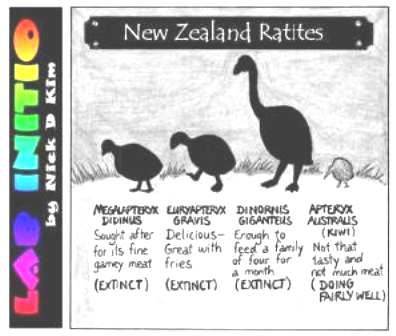
Moa may have been hunted to extinction within a century of human arrival to New Zealand. Moa made such easy prey that by AD 1200 the hunting of Moa alone provided food surpluses sufficient to provide for the settling of large villages up to 3 hectares. These villages were permanent coastal encampments from which bands would set out on several week hunts to slaughter and carry back Moa. Over 300 Moa butchering sites are known, 117 on South Island which together account for some 100,000-500,000 Moa. With such abundance came a good deal of waste: as much as 50% of usable weight was discarded in the field. At around the same time as hunting was at it peak, the forests of South Island were burned off. The extraordinary abundance of food resources supported a population of as many as 10,000 people. However, by the late 1400s the Moa hunting society collapsed. By about A.D. 1400 all moa are generally thought to have become extinct, along with the Haast's Eagle which had relied on them for food. Recent research using carbon-14 dating of middens strongly suggests that this took less than a hundred years
The kiwi were formerly regarded as the closest relatives of the moa, but comparisons of their DNA in a paper published in 2005 suggested moa were more closely related to the Australian emu and cassowary. However research published in 2010 found that the moa's closest cousins were not the emu and cassowary but smaller terrestrial South American birds called the tinamous which are able to fly.
The Dinornis seem to have had the most pronounced degree of sexual dimorphism, with females being up to 150% as tall and 280% as heavy as males. The females were so much bigger that they were classified as separate species until 2003.
NOTE:
Please find links to individual Moa species in the Taxonomy box, top right of this page. Links to each individual species are also available via the “bird gallery”, link at top of this page.
Other common names: —
kuranuni, manu-whakatau.
Description: —
Extinct bird
Poetry: —
Tenei, E tama! Te whakarongo ake nei ki te hau mai o te korero,
Na Tu-wahi-awa te manu-whakatau i mau mai i runga i a Tokomaru
Parea ake ki muri i a koe, he atua korero ahiahi.
Kotahi tonu, E tama! Te tiaki whenua, ko te kura-nui,
Te manu a Rua-kapanga, i tahuna e to tipuna, e Tamatea,
Ki te ahi tawhito, ki te ahi tipuna, ki te ahi na Mahuika,
Na Maui i whakaputa ki te ao;
Ka mate i whare huhi o Reporoa, te rere to momo
E tama - e - i!
Listen, my son, for I hear rumours spoken
That the manu-whakatau was brought here
By Tu-wahi-awa on the Tokomaru canoe.
Reject this story as an idle tale.
One guardian only, O son, had this land,
The Kura-nui, the bird of Rua-kapanga.
Destroyed by your ancestor, by Tamatea, with subterranean and supernatural fire,
The fire of Mahuika, brought to this world by Maui.
Thus were they driven to the swamps and perished;
Thus was the species lost, O son
— Transactions of the NZ Institute, Volume 48, 1916.
Illustration description: —
Death of the Moa, Trevor Lloyd water colour 1925, Auckland Art Gallery
Chasing the Christmas Moa - a joyous old-time Maori event: Mesenger, Arthur Herbert, 1877-1962, New Zealand Free Lance, Christmas annual, 1918.
Reference(s): —
Worthy, Trevor H., & Holdaway, Richard N., The Lost World of the Moa, 2002.
Oliver, W.R.B. New Zealand Birds, 1955.
Transactions of the NZ Institute, Volume 46, 1914
Anderson, A. J., The Extinction of Moa in Southern New Zealand, 1984.
The Natural History Museum, London:
Bone rings reveal slow growing giant moa
Page date & version: —
Tuesday, 27 May 2014; ver2009v1