Sitting over a pot of tea this morning, listening to all the bad news on the radio, my thoughts were suddenly penetrated by those four glorious, wonderful flute-like chimes of Korimako, the bellbird, reminding me to get my priorities straight. What is more important, I ask myself, the sound of the bell bird or the state of the economy and the burgeoning crime rate?
And there it is, perched singing in the bare kowhai tree near a banksia shrub, the honeyed flowers of which the bellbirds have come to enjoy during the winter.
For many years when I first came to the Valley, I was awoken almost every morning by a particular bellbird which started the morning, just before or on dawn, outside my window, with that single lovely bell like note which some bellbirds sound to perfection. Not to hear it of a morning was to leave me with a sense of there being something not quite right with myself or the world, rather like forgetting to meditate or pray. When he disappeared, ceased to sing outside my window, it left me with a real sense of loss, of desolation even.
Eventually another bird started to come as a regular visitor to the garden, although he did not sing outside my window first thing of a morning. He was quite a large bird with a very yellow under body and, as he was often in the banksia by the window, I could readily observe the red eye which identifies the male.
He was also around here for a number of years and commandeered the garden, even standing up to the tuis when they visited. The greatest delight and privilege was when he brought his young here one summer to feed. The fledglings uttered begging calls while he chivied them around giving the occasional harsh staccato alarm call but then he too disappeared, just this last summer.
The bellbirds have made this garden their own, the tuis being just infrequent casual visitors, coming mainly for the kowhai in the spring which they totally appropriate and will not let any other bird near. All my somewhat limited gardening ability has gone into planting mainly for the bellbirds but in spite of my efforts their numbers do not seem to increase.
There are never more than two or three birds here in the garden and as I walk my dog of a morning and evening, I seldom hear more than one at any time. And although I put out honeyed water in containers for them, it is Tauhou, the white eye, which takes advantage of it. The bellbirds merely check it out and then feed off either the flowers of the cestrum or banksia. Even the native trees on the farm such as puriri and rewarewa do not seem to attract many birds so there must be some reason other than available food supplies, such as predators, which limits their numbers.
According to the ornithologist, W. H. Oliver, the bellbird was undoubtedly the chief performer in the chorus described by Joseph Banks when Captain Cook entered Queen Charlotte Sound during the first voyage of discovery. “I was awakened by the singing of the birds ashore, from whence we are distant not a quarter of a mile. Their numbers were certainly very great. They seemed to strain their throats with emulation, and made, perhaps, the most melodious wild music I have ever heard, almost imitating small bells, but with the most tunable silver imaginable, to which, may be, the distance was no small addition.”
The impact of the European on the bellbird at first took the form of a rapid and alarming reduction in the number of birds, especially in the cleared portions of the country but also decreases took place in forested districts. The disappearance was most noticeable in the North Island and large areas are still without bellbirds. In 1873 Buller prophesized extinction for the bird but by the turn of the century it had started to make a modest comeback and followed the tui into suburban gardens, much to everyone’s delight.
They are apparently tenacious defenders of their nests and the female will physically attack an intruder. She has been known to fall to the ground and flap away to distract a predator. They are territorial during breeding season but after breeding they are usually nomadic and solitary moving around to food sources. They are strictly monogamous and pairs remain together for several years. They court in winter when the male sings in front of the female. After mating they often duet.
“Ka rite ki te kopara e ko nei I te ata” — like the bellbird singing in the morning — was a simile used by Maori orators. Korimako and Makomako are just two of the 26 names Maori had for the bellbird.
The bellbird, like the kiwi is especially our own, as it is found no where else but in New Zealand. I think there should be a national campaign to encourage people to plant their gardens for the bellbird. I am sure it would have a more positive effect on our gross domestic product than anything else which is presently being done.
— Narena Olliver, Waiotahi Valley, 1999

Song: —
Viking Sevenseas
This section should be replaced with an audio player, if not, please select the link below:
»»» Song of Korimako
Other common names: —
Makomako.
Description: —
Endemic bird
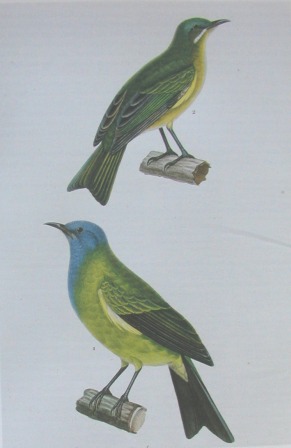
20 cm., male 34 g., female 26 g., male olive green, paler underparts, head purplish, tail and wings dark blue black, eye red; female browner with narrow white stripe across cheek, short curved bill.
Where to find: —
Common in many parts of the South Island, Stewart and Auckland Islands. Quite common in the eastern Bay of Plenty and off shore islands in the North Island. obscura is confined to the Three Kings Islands; and oneho breeds only on the Poor Knights; melancocephala was confined to the Chatham Islands but became extinct in 1906.
More Information: —
Youtube video —
Poetry: —
He rite ki te kopara e ko nei i te ata.
Like a bellbird pealing at daybreak.
Hutia te rito o te harakeke
Mai wai te komako e ko?
E patai atu ahau ki a koe,
He aha te mea nui o te Ao?
He tangata, he tangata, he tangata.
When you slice open the heart of the flax plant
Where will the Komako sing?
Let me ask you,
What is the most important thing in this world?
It is people, it is people, it is people.
Credit for the photograph: —
Kerry Gosling
Illustration description: —
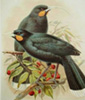
Duperray, L.I., Voyage autour du monde... La Coquille, ... Histoire Naturelle Zoologie, 1826.
Buller, Walter Lawry, Birds of New Zealand, 1888.
Reference(s): —
Heather, B., & Robertson, H., Field Guide to the Birds of New Zealand, 2000.
Oliver, W.R.B. New Zealand Birds, 1955.
Buller, Walter Lawry, Birds of New Zealand, 1888.
Page date & version: —
Monday, 26 May 2014; ver2009v1