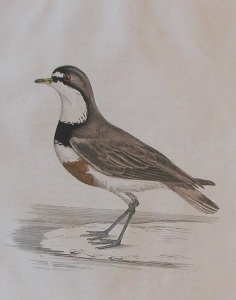
Though more common in New Zealand, this species was first discovered in New South Wales, whence specimens were described in 1827. Edgar Stead is the one writer who has written most eloquently about this delightful endemic bird, although it is now not so plentiful as it was in his day.
“The banded dotterel is the most plentiful of all the plover that breed with us, being found commonly throughout the South Island in suitable localities, and also, but more sparingly, in the North. ‘Suitable’ localities from a dotterel’s standpoint are areas covered with very short vegetation, or, better still, with no vegetation at all. Such places as shingle river–beds, the shores of both lake and sea, and more or less level patches in ‘tussock’ country are favourite resorts; as also is newly ploughed land, provided it is flat.
“Their call at all seasons is a staccato, high–pitched ‘pit’, sometimes repeated twice quickly, but often uttered as a single syllable at intervals up to thirty seconds, though much more rapidly when in flight. If a bird is standing still, it gives its head and body a little upward jerk every time it calls, the effect being exactly as though it had an attack of hiccups.
“The breeding season commences early. I have found young dotterel during the last week of August, but by the second week of September, most of the birds are building, and quite a number will be already sitting. The nest is a very simple construction, yet wonderfully well adapted to the bird’s needs. It consists of a little hole about three inches across with small pieces of moss, grass, wood or seaweed. I found a nest once in a ploughed paddock, where the hollow had been made in the top of a freshly turned furrow, and filled with wheat husks — a whole handful of them and nothing else. The eggs when laid are buried in the ‘lining’ of the nest, being always about half covered, and sometimes completely so. The result is one of the most inconspicuous nests that I know of. Three is the number of a full clutch of eggs, sometimes two, but never, in my experience, four. Both sexes take part in incubating the eggs.
“The young when hatched are covered with short down, the upper parts a golden brown speckled with black, the under parts creamy yellow, the tiny wings having the down longer, and white on its outer edges. They leave the nest within a day of hatching and accompany their parents in search of food, but at the slightest sign of danger the watchful old birds give the alarm, and the chicks scatter, run a few feet, and squat, their legs doubled up underneath them, and their head and neck stretched straight out in front, and pressed tight to the ground. They remain thus motionless, and, harmonising as they do to an amazing degree with their surroundings, are very difficult to detect. When so posed, they will allow themslves to be caught, and I have touched them, and sometimes moved them slightly with my finger, and they have made no attempt to run away. Yet when they do run, they are extraordinarily fast for their size, and if pursued, spread their little wings to give them better balance, and dodge with much skill.
“Young dotterel take readily to the water, and are good swimmers, using their legs rapidly and carrying their head and neck upright with a comical self–possessed air. They grow fast and are fully fledged in about six weeks from hatching. When feeding, the young do not cluster round the parents as do chicks around a hen, each trotting along by itself, and each, to a large extent, finding its own food., the old birds being nearby and supervising the proceedings. Until they begin to get their feathers, the young ones, on cold days, gather together at intervals and are brooded by the parents for awhile. For some time after the young are able to fly, they keep with their parents in the vicinity of the nesting site, but soon the family joins with others to form flocks near good feeding grounds. Their food consists chiefly of flies, grubs and insects, of aquatic larvae which they get by wading in the shallow waters at the edge of streams and pools; and the wire–worms and caterpillars which they get on ploughed land.
“In the back country of Canterbury there are many old river flats, where the shingle has been covered with a carpet of mosses, lichens and cushion plants, sparsely interspersed with tussock. During the hot summer months these places are parched and dry beyond belief, the sun strikes mercilessly on them so that the heated air from their scorched surfaces rises in shimmering waves. Most unlikely places, one would say, to find banded dotterel, yet strangely enough these birds are to be found there in numbers, even in January and Februrary; and stranger still, their food consists chiefly of the fruits of two plants of mat–like growth — Coprosma petrei and Muhlenbekia axillaris.
“Towards the end of January, a few dotterel begin to migrate; the main departure takes place in April, and by the beginning of May, most of them have gone to their winter quarters — some to Australia, and some to the northern end of the North Island. Of the birds that inhabit the South Island during the summer, a small proportion — I should say less than ten per cent — stay with us during the winter. In June and July and the first week in August, they may be seen flying in densely packed flocks, wheeling, rising, falling, or sweeping swift and low along the ground, always in unison as if at the dictates of a leader, now with their white breasts flashing in the sunlight, anon almost invisible as they turn their backs to the observer. During these flights, for the most part they maintain a constant ‘pitting’, but sometimes, when at a height, they will swoop at a speed angle towards the ground, and then fall silent, as if devoting every ounce of their strength to the attainment of speed. Close along the ground they will travel for a short distance, and then, all unexpectedly, settle, each bird standing tall for a few seconds with head raised, as if in a state of suppressed excitement Towards the end of July the winter residents are joined by the returning migrants.
“In the years previous to 1908, great numbers of dotterel were being shot by market gunners during the last few days of July, when the migrants returned, and the flocks still retained their close formation. In 1908 these birds were placed on the ‘protected’ list of New Zealand and have not much been shot since then.
“The birds which leave New Zealand in the winter go to Australia, where they occur in the coastal regions of Queensland, New South Wales, Victoria, South and West Australia. It has not been recorded as breeding anywhere in Australia, nor indeed as spending the summer there; the route these migrants follow is most interesting, for apparently they go via Auckland, Norfolk and Lord Howe Islands to South Queensland and South Australia, whence they work south along the coast to Victoria, Tasmania, South and West Australia.
“Banded dotterel moult twice a year, beginning to lose their breeding dress in December. By the end of the month most of them have lost the two bands across the breast, and the black and white frontal bands, but are still moulting the wings and tail. By March 21st they have again begun to grow their red and black bands, and many of them are in full nesting plumage by the second week in May.
“The banded dotterel is able to more than hold its own against all the natural enemies that have been introduced up to the present (1932); so unless the future sees the introduction of some more potent enemy than those already here (which God forbid!), it should continue to thrive”.
Other common names: —
Tuturiwhatu, double–banded plover.
Description: —
Endemic bird
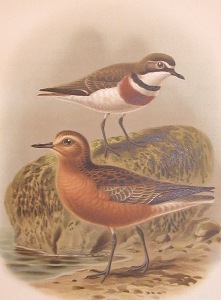
20 cm, 60g; adult in breeding plumage is white underneath with 2 bands, a thin black band on the lower neck and a broad chestnut band on the breast; non breeding plumage is variable but largely without the bands; short dark grey bill, black eye, yellowish, grey, green legs.
Where to find: —
Breeds on the shingle riverbeds of Hawke’s Bay, Manawatu and the Wairarapa and on the braided riverbeds of Marlborough, Canterbury, Otago and Southland. After breeding most birds head to the northern North Island of New Zealand or Australia. C. exilis is found on the Auckland Islands.
Credit for the photograph: —
Illustration description: —
Jardine, Sir William, & Selby, P.J.,
Illustrations of Ornithology, 1827.
Buller, W.R., Birds of New Zealand, 1888.
Reference(s): —
Heather, B., & Robertson, H., Field Guide to the
Birds of New Zealand, 2000.
Stead, Edgar F., Life Histories of New Zealand Birds, 1932.
Page date & version: —
Saturday, 17 May, 2014; ver2009v1