

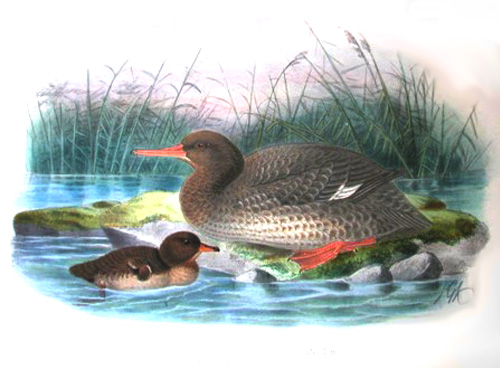
Buller, Walter Lawry, Supplement to Birds of NZ, 1905.
The Auckland Merganser was first discovered in 1839 when the two French corvettes, L’Astrolabe and La Zelee, arrived at the rarely visited and remote Auckland Islands. Charles Jacquinot obtained a merganser and published a description of it, jointly, with ship’s surgeon, Jacques Hombron. After the French visit the merganser does not appear to have been collected until 1874 when two were obtained by Baron Hugel from one of the crew of a visiting vessel to the islands. Reischek obtained two in 1888. Fewer than twenty species have been collected since, according to Oliver, who visited the islands in 1927 and found none.
“In Roman times the word Mergus, a diver, was applied by Pliny and Ovid to a kind of water-fowl. The vernacular ‘merganser’ apparently originated with the German naturalist Gesner (1516-65), whom Cuvier termed the German Pliny. In his Historia Animalium (1555) Gesner used the term Merganser — a combination of the latin words mergus and anser (goose) — for the group of fish eating ducks with great diving ability that Linnaeus later classified as Mergus. Mergansers constitute a subfamily of the Anatidae (ducks) characterised by a long, narrow bill with a hooked tip and with the edges of both mandibles set with numerous horny denticulations. In other ways they quite closely resemble diving ducks in structure.”
“There are four northern hemisphere species of Mergus and two in the southern hemisphere, the Auckland Island Merganser and one in Brasil... The closest relatives of the Auckland Island merganser are the Chinese merganser and the goosander, both of which occur in eastern Asia. Our merganser may owe its origins to the ancestors of one of these species during a hypothetical period when trans-equatorial migration had been adopted during the Pleistocene. Its evolution, primarily in New Zealand, entailed changes that are repeated in other bird colonists of southern islands, loss of male plumage, loss of pattern in the downy chick, and increasing tameness, if not reduction in the powers of flight. The only brood ever seen apparently consisted of four ducklings, suggesting that the clutch size may have been considerably less than that of the northern hemisphere species; reduced clutch size is another characteristic of insular forms.”
“Merganser bones from coastal sand dunes, some of them from the middens of the Maori have been identified by Scarlett, at first from South Island coastal deposits at Wairau Bar, Lake Grassmere, Kaikoura, and Old Neck, Stewart Island... With the Moas, the merganser disappeared from the main islands during the period of Maori occupation, probably as a result of ecological changes that the arrival of homo sapiens brought about with the introduction of the Polynesian rat and dog, extensive use of fire, and hunting pressures.”
“The merganser remained in the Auckland Islands but the introduction of the pigs (1807) and cats (1820) must have begun to reduce the population even before it was discovered in 1840. Some twenty six skins were collected during the next sixty-two years. The last known birds were a pair shot on 9 January, 1902, by the Earl of Ranfurly, the skeletons of which are now in the British museum,” says Fleming writing in George Edward Lodge, the Unpublished New Zealand Bird Paintings, 1982.

| Taxonomy | |
|---|---|
| Kingdom: | Animalia |
| Phylum: | Chordata |
| Class: | Aves |
| Order: | Anseriformes |
| Family: | Anatidae |
| Genera: | Mergus |
| Species: | australis |
| Sub Species: |
Extinct bird
Bill 60mm, wing 200mm, tail, 90mm, tarsus 40mm, mid toe 70mm: adult male: head and neck brown with a rufous tinge on the throat, foreneck and upper part of breast; a crest of brown feathers 5-6cm long on back of head; back, wings and tail blackish brown, a patch of white on the secondaries and greater wing coverts; lower breast and abdomen greyish brown with longitudinal white bands; sides greyish brown, the feathers edged with white; auxillaries white; bill yellowish orange, blackish on culmen and at tip; iris dark brown; feet orange, webs, joints and soles dusky. Adult female, similar to male but smaller.
Extinct
Buller, Walter Lawry, Supplement to Birds of NZ, 1905.
Kear, J., and Scarlett, R.J., 1970, Wildfowl, Vol.21
Oliver, W.R.B., New Zealand Birds, 1955.
George Edward Lodge, the Unpublished New Zealand Bird Paintings, 1982.
Monday, 14 August, 2023; ver2023v1